

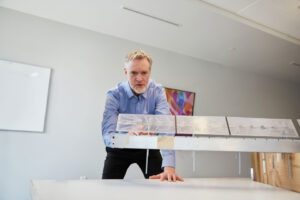

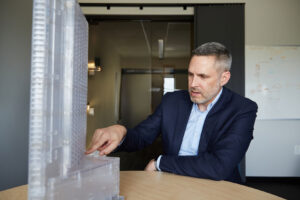



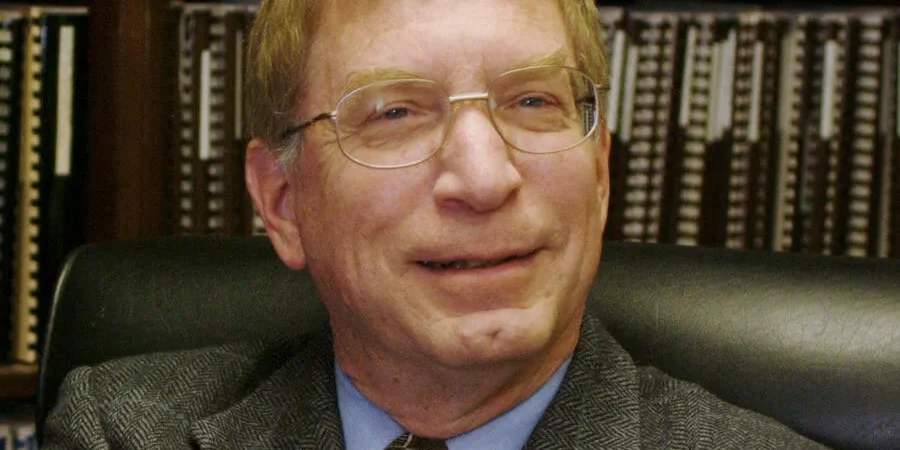
CPP, Inc., is at once delighted and filled with regret to announce the retirement of Dr. Jon Peterka, one of our company’s original three founders. Jon’s last day of active service with CPP was February 28, 2014. Although we are sorry to see Jon go, we are excited for the new opportunities and experiences that await him in the coming years.
In celebration of Jon’s illustrious career, we reflect back at his more than 50 years of contributions to wind engineering and look ahead to what the future will bring.
Jon Peterka’s career in wind engineering started almost as quickly as his undergraduate program. During his third year as an undergraduate student at Colorado State University (CSU), Jon began working in the laboratory of Dr. Jack Cermak, with whom he would eventually found the company that is now CPP. Jon earned bachelor’s and master’s degrees in civil engineering from CSU before attending Brown University for doctoral studies in fluid mechanics and thermodynamics.
After earning his Ph.D. at Brown, Dr. Peterka served for three years at the Army Missile Command in Huntsville, Alabama, where the seed was planted for what would later prove to be one of the most notable aspects of his career: forensic engineering. Jon arrived in Huntsville just six months after a series of detonations on the launch pad had puzzled engineers working on the MGM-52 Lance missile. By applying numerical techniques by hand, Peterka successfully predicted the detonation behavior to within 0.01 seconds.
In 1971, Dr. Peterka returned to Colorado and accepted a tenure-track position as a professor of Civil Engineering, a role he would continue to serve until 1993. It was as a CSU professor that Jon’s career in wind engineering assumed the form that is so widely recognized today.
Working alongside his former advisor, Dr. Cermak, Jon began to study in detail how buildings responded to wind. The first wind loads study that Jon supervised took a team of students and professors working two shifts a day, six days a week, for six weeks to gather data that today’s engineers at CPP can measure in less than an hour.
In the coming decade, Jon was instrumental in improving the lab’s technical capabilities. So much so, that by the late 1970s, industry had taken notice. The university laboratory was performing so many projects for commercial clients that a new approach was clearly required. An approach that would allow researchers to study the fundamental problems of wind engineering while still offering the private sector the resources for which there was clearly a demand.
In 1981, the pair founded Cermak, Peterka, and Associates.
It took about two years for CP/A, as the organization was then called, to get on its feet. Everything was built from scratch. From software and analysis procedures to data collection equipment and the wind tunnels themselves, all aspects of the new business were designed and built from the ground up. In those formative days of what would become CPP, Inc., Cermak and Peterka focused almost exclusively on wind loads on structures. But one kind of load in particular caught the attention of industry professionals.
Wind loads can be divided into straight line loads (forces) and twisting loads (moments). For convenience, engineers break each of these, in turn, into three individual forces or moments that represent the three dimensional world in which we live. When speaking about structures, for example, one might consider a force as having components that act in the east-west direction, in the north-south direction, and in the up-down direction. The real total force is the sum of all three acting together.
Building code procedures at the time offered no way to estimate one of the three components of twisting moments. Torsion, which is the tendency of a building to twist around a vertical axis under certain wind conditions, was not addressed in the code, and industry professionals needed a way to design for these conditions.
Cermak and Peterka were able to deliver torsional loads to clients as part of their wind tunnel testing services. The ability to quantify this load represented an important development in how buildings are designed for wind. Take a look at any modern skyscraper, and you’re unlikely to find simple square or rectangular cross-sections. Today’s tall buildings include structural features that disrupt the wind patterns that cause torsion and other load mechanisms.
In 1984, Ron Petersen joined Drs. Cermak and Peterka, and the company was renamed Cermak Peterka Petersen, or CPP. Dr. Petersen not only brought his detailed understanding of exhaust dispersion with him; he also brought many of the critical components of what is now Wind Tunnel 2 at CPP.
As the work of Cermak, Peterka, and Petersen defined the industry, Dr. Peterka continued serving as a professor at CSU. His passion for teaching had led to his being awarded the prestigious Honors Prof Award in 1977 and two teaching awards in the years since. But after more than two decades with CSU, the challenge of balancing dual full-time jobs led Jon to retire from academia to focus exclusively on the work of CPP.
Dr. Peterka also found himself increasingly involved with the American Society of Civil Engineers, or ASCE. One of ASCE’s many roles is the publication of Minimum Design Loads for Buildings and Other Structures (ASCE 7), which serves as the basis for building codes nationwide. And it is Dr. Peterka’s contributions to standards like ASCE 7 that will prove among his greatest legacies.
The ASCE 7 Subcommittee on Wind Loads is tasked with the not insignificant role of codifying the procedures by which engineers calculate wind loads on buildings in most of the United States. In the mid-1980s, the Subcommittee was limited to one member per organization, and Jack Cermak served as CPP’s delegate for years.
But as Dr. Cermak’s alternate, Dr. Peterka filled in when Jack couldn’t attend, and he made major contributions to the group well before achieving full membership. Peterka was instrumental in the decision to shift the basis of the wind code from what is known as a fastest mile wind speed to a peak gust wind speed. The nomenclature may be unfamiliar to those who don’t work in wind engineering on a day-to-day basis, but the distinction is considerable. Designers around the world now use the peak wind gust when they estimate wind loads on buildings and structures.
In 1995, Peterka’s contributions heavily influenced the development of the wind map for non-hurricane regions of the United States. The new map greatly simplified how engineers determine design wind speeds for locations around the country and consequently reduced confusion and improved code compliance. The national wind map remains largely unchanged to this day.
Jon also chaired the ASCE-49 Standards Committee on Wind Tunnel Testing, which publishes Wind Tunnel Testing for Buildings and Other Structures. This document defines the best practices and standards that must be followed to accurately measure wind forces in a wind tunnel simulation. Peterka’s work with ASCE-49 also led to the inclusion of a chapter on how to use wind tunnels to estimate snow loads, a valuable service that has served CPP’s clients for many years.
Through his tireless contributions to ASCE, Jon Peterka has had a significant impact on how modern wind engineering is practiced.
Dr. Peterka’s retirement from CPP may mark the end of his official role with the company, but it hardly heralds the end of his career. Jon will serve CPP as an expert consultant from time to time, and he will continue offering expert testimony in legal cases as he has for many years. As a world expert in wind loads on shingles and low-rise buildings, demand for Jon’s legal opinions shows no signs of abating.
But it’s not all work and no play. For more than thirty years, Dr. Peterka has enjoyed writing poetry, and he plans to use some of his newfound free time to finally realize its publication. Never one to shy away from complexity, Jon plans to self-publish his work and see it through every step of the process, including formatting and illustration.
We at CPP are honored to have worked with Dr. Jon Peterka for more than thirty years, and we trust that his years of retirement will be every bit as distinguished as his years with us.
Link to full article here.