










We all understand what wind is—at least experientially—from an early age. It’s as much a part of the human experience as sunshine, rain, and snow. But what exactly is wind? What causes it?
Merriam Webster defines wind as “a natural movement of air of any velocity.” Wind is, then, simply the movement of air from one place to another. Air is a blend of nitrogen, oxygen, and other gases, and as those molecules move from point A to point B, they exert a pressure on everything they come into contact with. The faster they move, the greater the force upon impact, whether it be your exposed face or the side of a building. And that force is what we experience as wind.
The driving force behind wind is atmospheric pressure (Pressure is simply a force distributed over an area). Just as water always flows downhill, air always moves from areas of high pressure to areas of low pressure. But what causes pressure differences in the first place?
Lots of things, as it turns out. Here are just a few:
-
-
The moon exerts a gravitational pull on the atmosphere just as it does on the oceans, creating atmospheric tides (and the corresponding waves) similar to those observed at the beach.
-
As the warmth of the sun heats illuminated areas, the density of the atmosphere in those areas decreases, while dark areas remain relatively cool. The resulting difference in pressure sets up an air current.
-
-
-
Buoyancy—the tendency of low density air to rise above more dense air—drives air from the poles (cold, dense air) to the tropics (warm, less dense air).
-
-
-
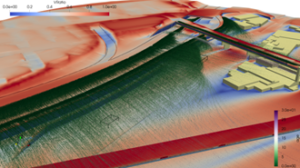
Topography prevents air from moving uniformly across the surface of the earth and creates wind shear between ground level winds and those slightly above. This contributes to localized winds that wouldn’t otherwise be present in the bulk flow.
-
The earth’s rotation induces a Coriolis force, which causes air to deflect toward the equator as they move.
-
For a natural phenomenon we encounter on an almost daily basis, the physics behind wind is strikingly complex. But by understanding what causes wind, and, therefore, what is likely to cause wind-related problems, engineers can design modern structures that are optimally reinforced to withstand all that nature throws at them.