




Developers planning a building

Design Development

Atmospheric wind is not a uniform phenomenon: It continuously changes speed and direction. At ground level in a built environment, the local turbulence intensifies this variance. A pedestrian will experience these rapid changes in wind, which we call gusts.

It’s these variations in gust speed, direction, duration, and size that are responsible for the different wind loads that affect different parts of a structure. Gusts that are larger than the characteristic dimension of a building will “appear” as a sustained wind to the building. These are the gusts that tend to push, pull, and twist the building’s frame and foundation.

Gusts that are smaller than the characteristic dimension tend to create more localized effects. A window here, a shingle there, and so on. A gust most acutely affects structures that are smaller than it is. A window-sized gust is inconsequential to a building.

Gusts come in all sizes, from those as large as mountains and valleys, all the way down to the very smallest gusts that friction between air’s constituent molecules can dissipate. The distribution creates a spectrum of influence where larger gusts contain more energy overall, but smaller gusts have a greater correlation to higher local pressures. These phenomena are responsible for separate loads for the Main Wind Force Resisting System (MWFRS) and components and cladding (C&C) design.

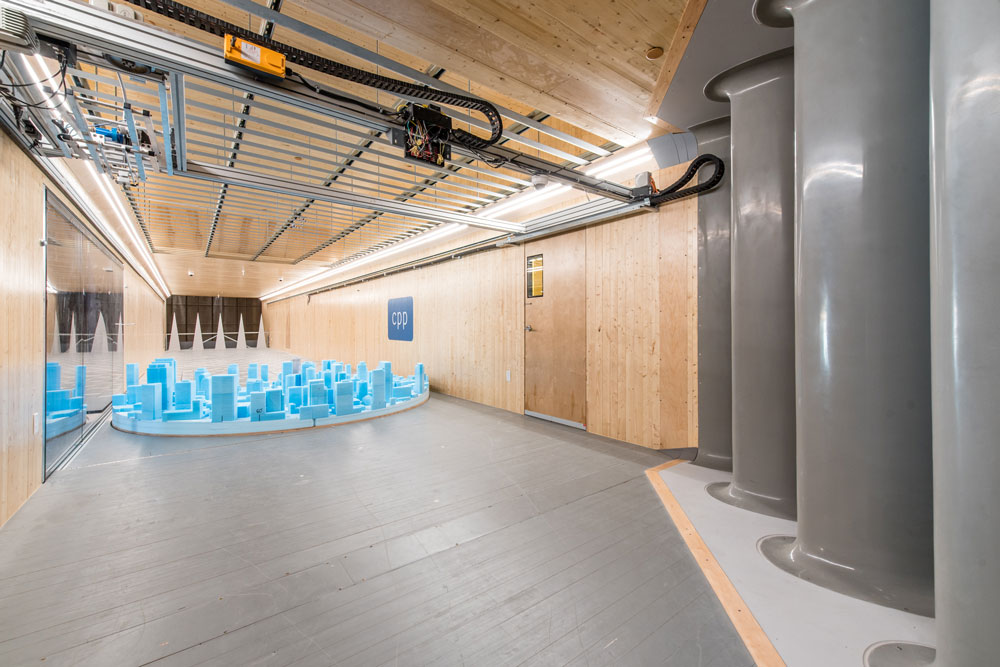
At CPP Wind Engineering Consultants, our state-of-the-art boundary layer wind tunnel is used to conduct comprehensive C&C studies for all types of structures especially those with unique architecture and geometry. These tests allow us to capture the unique interactions of these large and small gust effects. Design codes and standards are not intended to capture these complex wind effects associated with unique geometries, site conditions, and structural dynamic behavior.

Wind tunnel studies can quantify, not only, the C&C pressures, but also door operability, stack effect and paver uplift. Site-specific wind climate analysis is incorporated with consideration of storm-type and directionality. For C&C design, building specific design pressure maps replace the zones provided in design codes. These studies provide engineers with reliable, project specific wind loads to achieve the intended levels of structural reliability, safety, and serviceability while optimizing material use, reducing embodied carbon and complying with applicable codes and standards.

Wind interacts with buildings and structures in complex and often surprising ways. A building’s geometry, the surrounding terrain, nearby buildings and structures, and seasonal wind conditions all influence the way wind interacts with a building. Wind considerations are especially important for cladding and structural design.

Wind tunnel testing offers specific, customized information about a particular building or structure, making it a key tool for efficient design. Wind tunnel testing can identify areas to reduce material costs and increase resilience and reliability.

Being conservative with your structural materials can increase costs and waste. Being unconservative can increase risk and potential repair and mitigation costs. Including wind engineers on your construction team can help you specify structural requirements that are robust where they need to be without being over-designed.

Exhaust systems are intended to safely remove pollutants from buildings. However, wind can create air flow patterns that divert building exhaust back into air intakes or to other sensitive locations such as outdoor amenity spaces or neighboring buildings. An exhaust system achieves its purpose when pollutants no longer contaminate your building, nearby buildings, or areas where people spend time.

We have over 40 years of experience solving exhaust-related issues both during design and for existing systems. The sources most commonly evaluated include odors from commercial kitchens, diesel generators, helicopters and other idling vehicles, as well as health/odor concerns from laboratory spaces, infectious isolation rooms in hospitals, and other similar building exhausts.

Our engineers use industry-leading modeling and analysis methods to evaluate the effects of your building’s emission sources. Our goal is to offer efficient, cost effective, solutions that complement your design without compromising safety.

Unsafe Lab Exhaust

Safe and Efficient Lab Exhaust

Inefficient Lab Exhaust

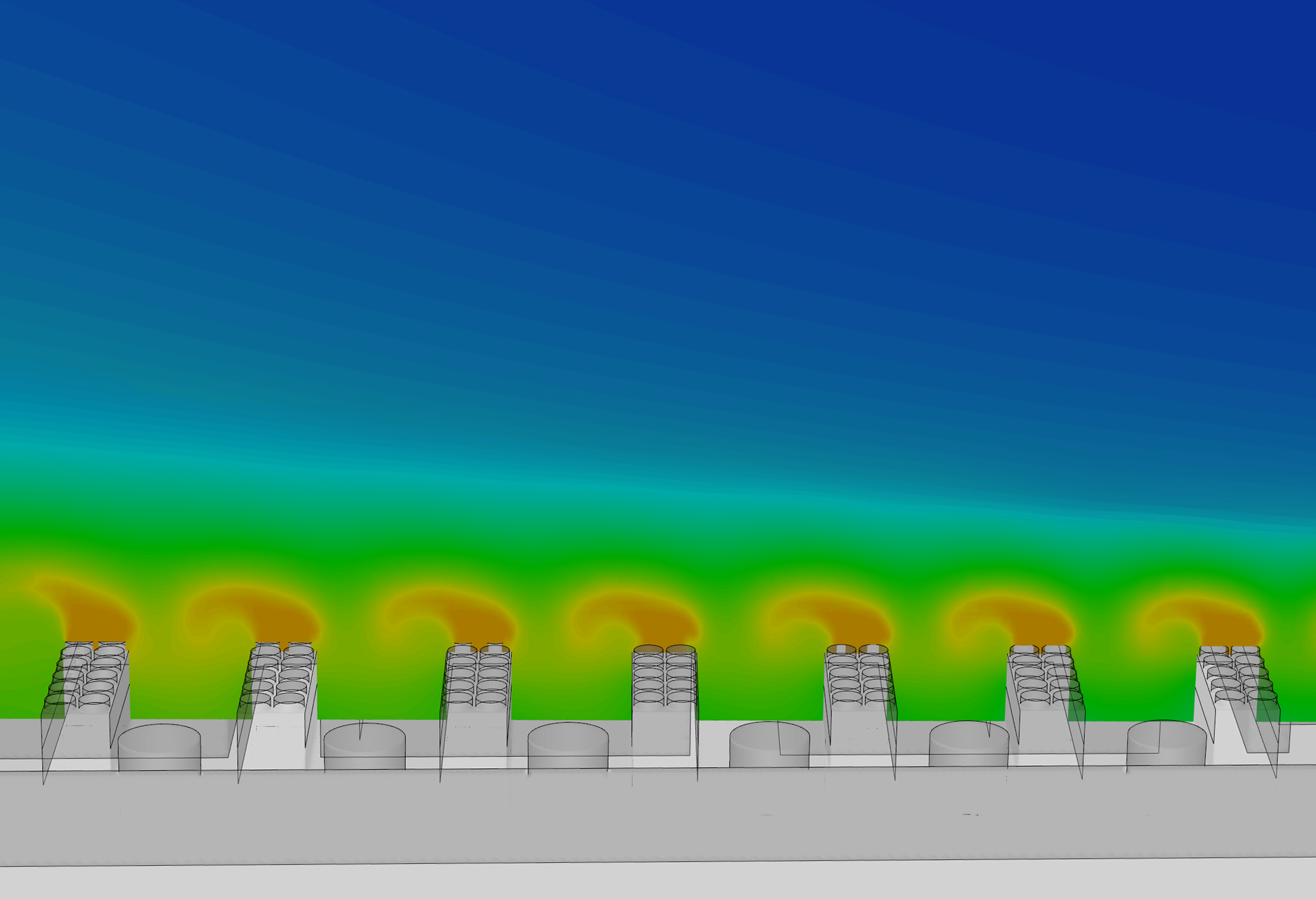
Recent years have seen a rapid transition from water-based cooling for buildings, such as cooling towers, to dry, air-based cooling such as air-cooled chillers and air source heat pumps. For many applications such as data centers, hospitals, and tall buildings, designers often place multiple units in close proximity and enclose them within a screen-wall to hide the equipment.

CPP has applied our knowledge from years of plume dispersion modeling to help solve cooling capacity challenges that result directly from inadequate thermal plume dispersion. We have provided consulting and modeling for multiple existing systems and now commonly provide the same during the design phase to quantify the likelihood of plant capacity issues and to evaluate alternative designs.

We use tools ranging from plume dispersion experience and climate analysis to very-fast screening level modeling using a proprietary dispersion model (designed specifically for this application) to wind tunnel modeling. Our wind tunnels can simulate all wind directions and wind speeds, incorporating local hourly climate data, to help designers, developers and operators predict cooling capacity on an hourly basis.

If you are having challenges with your current system or have more than five units in a planned design, we can help.

exhaust plumes from chillers

Unless new buildings are evaluated for outdoor wind comfort issues, they can make things worse for pedestrians, cyclists, and patio diners. Our wind experts have diagnosed and solved outdoor comfort problems for more than forty years. We understand how winds near buildings behave and how to anticipate and reduce the risks of these environmental winds.

Wind creates special airflow patterns when it interacts with a building. When a new structure is built, surprising problems often occur. A peaceful outdoor café, garden, or jogging path might suddenly experience surprisingly strong winds. Furniture on pool decks or balconies could be blown around, possibly piling up on one side or in a corner.

These effects can be surprising, but they’re also predictable and preventable. At CPP, we understand how buildings and structures affect wind patterns. We use this knowledge to help you protect the outdoor experiences and overall comfort of people walking or lounging near the building.

Thermal comfort in outdoor environments is shaped by the combined effect of wind, air temperature, solar radiation, and humidity acting on the human body. A sheltered spot that eliminates wind discomfort may still be unbearably hot in summer; a breezy terrace that feels pleasant in spring can become a cold stress environment in winter. Understanding the full picture is essential to designing spaces that people genuinely want to occupy.

CPP combines rigorous meteorological analysis with high-resolution numerical simulation to give developers and architects a precise, evidence-based picture of thermal conditions at any location worldwide.

Every assessment begins with the climate. Meteorological records specific to the project location are sourced and processed to establish a statistically robust baseline of temperature, solar radiation, prevailing winds, and seasonal variation. This is not generic regional data – it is site-calibrated analysis that reflects the actual climatic reality a project will inhabit, whether that is a humid tropical coastline, a continental city center, or a high-altitude alpine environment.

That climate is then brought to life through simulation. Using computational fluid dynamics (CFD) and thermal radiation modelling, the microclimate generated by the specific building geometry, surrounding context, vegetation, and materials is modelled in detail. The result is a spatially detailed picture of conditions at the human scale – at ground level, on terraces, around building entries, and across public realm and across the seasons and times of day that matter most to the project.

All outputs are reported in Universal Thermal Climate Index (UTCI), the internationally recognized standard for outdoor thermal stress. The methodology applied is consistent with the most rigorous thermal comfort guidelines and planning frameworks currently in use.

Thermal comfort assessment identifies where thermal stress is likely to occur, what is driving it, and how targeted interventions – shading structures, wind screens, vegetation, and surface material choices – can shift conditions into the comfort range. From residential masterplans to mixed-use precincts, hospitality developments, and urban public spaces, CPP’s thermal comfort assessment provides the confidence that outdoor environments will perform – and that the people who use them will choose to stay.

Wind flow around buildings, and their associated wake effects, can produce wind conditions with the potential to affect the safety of helicopter flight operations. In the wind tunnel, we can quantify these effects for comparison against international criteria to identify potential challenges for helicopter operations and provide design or operational alternatives to minimize the potential for adverse results.

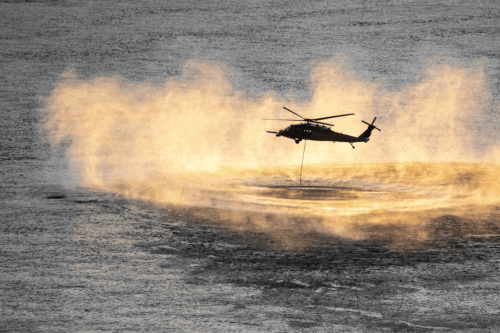
Helicopters can generate horizontal wind speeds exceeding 80 mph as they approach/depart from their landing pads. These speeds are sufficient to transport stationary objects, potentially cause injury, and produce unusual load combinations on nearby structures such as equipment screen walls. Our experts can provide advice based on simple models accounting for the size and weight of a helicopter or provide project-specific simulations of rotor wash as a helicopter approaches and departs a landing pad. This information can be used to inform design and to develop operational protocols to minimize the chance of damage or injury.

helicopter rotor wash over water

Indoor environment modeling can be used to achieve a range of objectives relevant to different situations. Detailed Computational Fluid Dynamics (CFD) simulations are the ideal tool to help designers understand how specific HVAC arrangements can be used to achieve separate, and often competing, goals. Typical examples include:

  • Ventilation effectiveness/contaminant removal (laboratories, parking garages)
  • Occupant comfort (office, patient room, atrium, etc.)
  • Thermal environment uniformity (animal spaces, indoor farming, manufacturing)
  • Natural ventilation (ventilation effectiveness and occupant comfort)
  • Sports arenas and other large volume facilities are good examples of criteria differences for areas within a space.

Our experts can provide advice early in design considering various schemes that could be used to meet the project goals most efficiently, and to ensure space is reserved for anticipated ductwork. Detailed modeling can be provided during the appropriate design stages to compare systems and/or to optimize the selected system.

Understanding how wind loads impact paver systems can widen the design possibilities, simplify the installation, and reduce costs. Elevated paver systems are installed above the roof surface with small perimeter gaps around individual pavers. When air pressure in the cavity equalizes and approaches the external pressure, there is reduced wind loading on the paver itself. However, without sufficient design care, pavers can still be dislodged or even lifted off the roof.

It is crucial to quantify the degree of pressure equalization. Estimations are based on research or more accurately evaluated in wind tunnel studies.

For paved terraces, balconies, and accessible roof surfaces, measurements from a wind tunnel pressure study can predict the uplift wind pressures for the paver system design. Uplift wind pressure is related to paver arrangement and cavity depth below. CPP can help the design team understand the effect of these parameters and assist in specifying a safe and reliable system.

Reliable wind engineering service gives the design team flexibility to vary paver materials and dimensions and assess the need for lockdown systems to resist the uplift wind pressure.

The line between inside and outside is increasingly being blurred, with high demand for extensive outdoor amenity spaces. The performance of these spaces is often critical for the success of the development. While furniture can be critical in supporting user comfort within these spaces, the items are also at risk due to wind exposure – items can tip, slide or uplift due to wind forces. Even if it isn’t a storm for the record books, complex building aerodynamics can result in higher risks for furniture movement.

Early on in design, guidance can be provided to assess risk and what types of furniture are more wind resistant and likely to perform better. Further into design, wind tunnel data can be leveraged with furniture specifications to provide the frequency of expected movement due to wind forces and recommend ballast or anchoring to improve performance.

It’s never too late to get guidance and support, CPP has helped clients activate underutilized roof spaces to provide better amenities and also provides site visits and forensic assessments if there have been issues or concerns with existing spaces.

It’s neither possible, practical, nor even desirable to create a perfectly quiet environment, but studies consistently demonstrate that noise can cause stress. And it’s not usually the noise itself but a feeling of lack of control that irks aurally assaulted employees. Fortunately, techniques are available to architects and building managers that can effectively reduce noise pollution to manageable levels. Here are three effective ways to give office workers room to hear themselves think.

  1. Strategic office design. If you’re building a new space, then you enjoy the advantage of a blank canvas to work with. Placing equipment like fax machines, copiers, and printers in a separate workroom keeps beeps and buzzes from contributing to a computerized cacophony. If you have control over the building envelope, double glazed windows, special roofing elements, and good ventilation design can keep outside noise from coming in. And vibration isolation systems can prevent upstairs occupants, mechanical systems, and water pipes from creating periodic distractions.
  2. Acoustic absorption. Sound is nothing more than pressure waves that our eardrums detect and our brains interpret. And like other waves, sound waves reflect off of hard, solid surfaces rather effectively. But sound absorbing devices like wall panels, hanging baffles, perforated screens, and upholstered furniture reduce sound reflection and contribute to a more peaceful work environment. Anechoic chambers and recording studio isolation booths offer extreme examples of this technique in action.
  3. Sound masking. There’s a reason retail stores and restaurants play the music they do: Every track is carefully chosen to encourage customers to eat, shop, and linger. Plus, pleasant background noise can distract from less pleasant sounds like the ringing of registers. Office managers can take advantage of such techniques by playing ambient music at a low volume or by introducing low levels of white noise. The idea is to deliver spatially and temporally consistent background noise that subtly competes with other sounds for the listener’s attention without drawing undue attention to itself.

Keep in mind that a perfectly quiet environment can actually make employees feel less comfortable than one with some noise: A certain level of background noise enhances privacy, promotes a sense of activity, and helps set the mood of a space.

The success of outdoor areas and of the transition zone between outdoor and indoor spaces can depend on adequate management of the local wind-rain climate. Under calm conditions, it is reasonably straightforward to design adequately sized canopies and overhangs to protect sensitive amenity areas. However, rain seldom falls vertically or at a constant angle. When wind and rain combine it can become more difficult, and our modelling can be of assistance.

The trajectory of rain (and therefore the rainfall intensity at a location) is a function of both the raindrop size and the wind speed field through which the drop must travel in order to reach its final impact point. Our study considers the variable range of raindrop sizes present in different types of rainfall events, and combines them with modelling of the wind field around the development to enable tracking of rain trajectories and maps of wetted areas.

Our study begins with a review of the local wind/rain climate at the project location. This analysis considers historical data and characterizes how often it rains, from which wind directions, at what wind speeds, and at which rainfall intensities. From this analysis, patterns in the wind/rain climate will be extracted to determine the simulations to be conducted. Typically between 5-15 simulations are required to provide a reasonable assessment of the rain performance of the project. These could include for example three wind directions at four wind speeds each. The simulations make use of a multiphase method and each include the transport and summation of up to 17 different raindrop sizes.

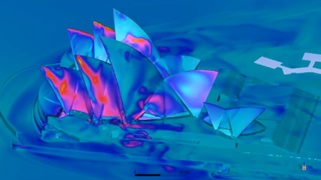
Sun disability glare occurs when direct or reflected sunlight is projected onto the retina of the human eye causing poor visibility. When driving solar glare interferes with contrast, sharpness perception, and vision acuity. Increasing urbanization in many cities is leading to higher traffic volumes exposed to solar disability glare reflected from increasingly taller building facades. CPP can assess newly proposed buildings envelopes during concept design to identify potential for sunlight to reflect from exterior cladding surfaces and create traffic disability glare hazard onto surrounding roadways.

Our experts maintain membership of the International Commission on Illumination (CIE) being the international authority ‘on all matters relating to the science and art of light and lighting, color and vision, outdoor and indoor lighting and design, photobiology, and image technology’ (www.cie.co.at). CPP employs established methodologies to calculate potential for mirror like specular façade reflections off glazing to create traffic solar glare hazard. Key metrics include Holladay veiling luminance Lv and Threshold Increment as a measure of contrast reduction at roadway receiver locations, also quantified in terms of population dosage for risk assessment.

Modern facades are increasingly adopting metal sheet cladding products displaying diffuse reflective surfaces. In-house software has been developed to perform solar reflection calculations for these products with flat and curved geometries. The program generates view-based luminance renderings at traffic receiver locations which are evaluated using a custom script to determine annual disability glare metrics for comparison with disability glare criteria.

In addition to the glare metrics, we can also quantify potential for increased solar heat load at ground level, and other critical locations. This can be particularly important for curved facades to ensure that reflected solar rays don’t combine in a manner that could harm pedestrians or damage/melt/ignite local building elements, vehicles, or vegetation.

Good ventilation strategies create healthy and attractive indoor spaces. Researchers have found evidence that inadequate airflow lowers performance of office work and ventilation rates are correlated to employee efficiency. Our natural ventilation modeling and analysis services can help you design your commercial/residential space to boost well-being, satisfaction, and productivity of occupants.

Natural ventilation is as simple as opening windows to encourage a gentle breeze across your desk and, moreover, a comprehensive strategy will identify the best opening combinations for your building location to optimize airflow and indoor comfort for specific indoor activities and times of the year. Amenity/exercise rooms provided in offices, apartments and event spaces are good candidates for enhancement by natural ventilation.

Mechanical heating and cooling is often needed to cope with the coldest and hottest times of the year; however, natural ventilation can dramatically reduce use of mechanical ventilation when outdoor temperatures are mild. When properly designed, natural ventilation can work together with mechanical ventilation to minimize your building operating cost.

More Services from CPP

architects designing a building
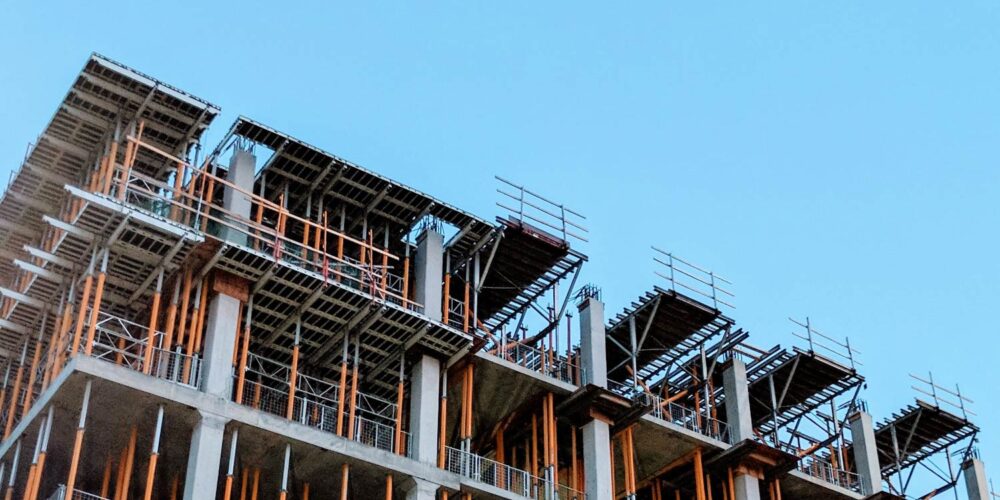
constructed building under renovation

More Solutions from CPP

solar panels transmission pylons and wind turbines
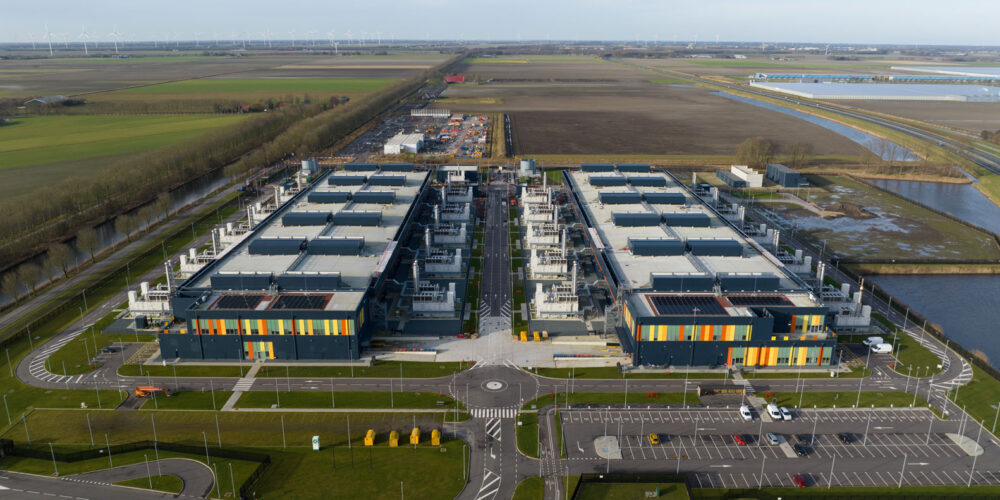
data center